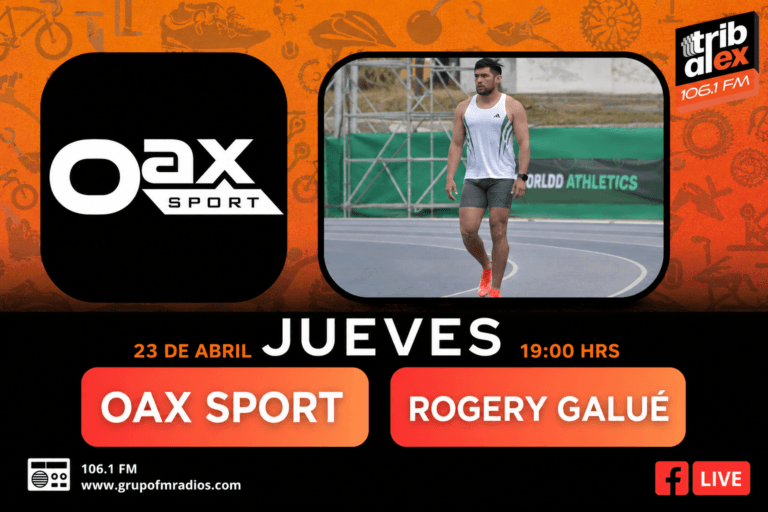

Original language: Spanish (radio segment on Tribu al Extremo, 106.1 FM).
By Juan Zurita Victoria, MBA
Oax Sport. Athlete Support and Programs.
Report also available in Spanish and French.
This blog series
This post is part of Oax Sport Thursdays on Tribu al Extremo (106.1 FM), a weekly space for athletes, coaches, sport education, and community support in Oaxaca.
Read the previous episodes: Episode 0, Episode 1, Episode 2, Episode 3, Episode 4, Episode 5, Episode 6, Episode 7, Episode 8, and Episode 9.
Episode details
- Host and text: Juan Zurita Victoria.
- Guest: Rogery Galué.
- Hometown: Salina Cruz, Oaxaca.
- Events: 100 m and 200 m.
- Coach mentioned: Coach Uber.
- Show: Tribu al Extremo (106.1 FM).
- Segment: Oax Sport Thursdays.
- Focus: sprinting, discipline, national competition, high-performance training, injury, work, nutrition, and returning to competition.
- Air date: Thursday, April 23, 2026.
- Listen live: every Thursday, 7:00 p.m. to 8:00 p.m., Oaxaca time.
Focus of the week
This episode followed Rogery Galué’s development from neighborhood races in Salina Cruz to national youth competitions, high-performance training, university athletics, and his return to sprinting while working full time.
Rogery Galué spoke about the influence of his father, his coaches, competitive training partners, structured nutrition, and the decisions required to remain in athletics after university.
This episode did not cover a specific Oax Sport support case.
Results shared in the interview
The following results and times were shared by Rogery Galué during the interview:
- 100 m personal best: 10.77, recorded in 2023 during a university qualifying competition.
- Youth national title: 10.94 in the under-18 100 m in 2015.
- Ibero-American youth result: bronze in the 100 m with 10.93 and a reported headwind of 2.7 meters per second.
- 200 m personal best: 22.20, recorded in Querétaro in 2018.
- 2014 youth results: 22.37 for silver at Olimpiada Nacional and 22.34 at a Central American competition.
- Return to competition: 11.16 after about 2 years without competing.
These figures come from Rogery Galué’s account during the radio interview. The episode did not include official result documents.
30-second recap
- Rogery Galué began formal athletics training in Salina Cruz in January 2012.
- He reached a national competition during his first year in the sport.
- He credits discipline, family support, coaches, and competitive teammates for his progress.
- He became a national under-18 champion after running under 11 seconds for the first time.
- He trained at Mexico’s National High Performance Center and learned how greater training loads affect recovery.
- A sports scholarship allowed him to study at Universidad Anáhuac Oaxaca.
- He now balances work, nutrition, recovery, and selected high-quality training sessions.
Interview in text
1. Early races, family, and first discipline
Q (Juan): How did you begin in athletics?
A (Rogery): Since kindergarten and primary school, I liked running short races. In Salina Cruz, I raced other children from the neighborhood. I later played soccer as a goalkeeper.
During secondary school, I was invited to compete in an interschool athletics event. I won the local race, and Profe Raimundo Sosa invited me to prepare for Olimpiada Nacional. I was focused on soccer, so I first said no.
One or 2 months later, he spoke directly with my father. My father told me that I could accept, but I had to do it with discipline and commitment. He did not want me to agree one day and quit the next morning.
I trained for about 2 weeks and went to the state competition in Oaxaca City. I won silver in the 100 m and finished around fourth or fifth in the 200 m. I then advanced to the regional stage at UNAM in 2012.
I finished sixth in the 100 m, and our relay won silver. That result qualified us for the national competition. I had trained for only 2 or 3 months. Seeing athletes from other states, the competition, and the atmosphere made me want to return the next year in an individual event.
Q (Juan): When did you begin taking the sport seriously?
A (Rogery): My father influenced that decision. I started during the December and January school break. Training began at 7:00 a.m., but I was used to soccer practice at 9:00 or 10:00 a.m.
At first, getting up that early was difficult. After about 2 weeks, I began to like the fact that the result depended on me.
An athlete still has a team around them. Parents and coaches have a strong influence. At that time, I did not yet understand the work of a psychologist, nutritionist, or physiotherapist. Later, I learned how much all those people can affect an athlete.
2. His first competition
Q (Juan): What do you remember about your first formal competition?
A (Rogery): I was extremely nervous. I have gaps in my memory from that day because I lost awareness of what was happening around me.
The main instruction I remember was, “Run and do not look to the sides.” During practice, I used to turn my head to see where the other runners were. My coaches told me that looking across the lanes would cost me time.
My technique was poor at that time. It is still something I work on, but it was much worse during that first competition.
3. Talent and discipline
Q (Juan): How much do talent and discipline matter?
A (Rogery): I have often considered myself an athlete without much natural talent because I have trained with people who had exceptional ability.
There are different types of talent. I strongly believe discipline allows a person to develop the ability they already have. I have also met athletes who did not appear especially talented but were disciplined and determined. They were able to compete at the same level as people with greater natural ability.
Talent matters. Discipline decides how much of it you use.
4. Responsibility toward younger athletes
Q (Juan): What does it mean when people describe you as one of Oaxaca’s fastest sprinters?
A (Rogery): I have not always viewed myself as the fastest athlete in Oaxaca. As I became more conscious of that description, I began trying to give more support and advice to younger athletes and children.
Younger athletes need to understand what they must do every day to reach their own goal, whether that goal is a state competition or a national one. The daily choices decide the outcome.
I asked myself what I was willing to do to become a national champion. From secondary school onward, I stopped going to parties. I did not drink or smoke. That discipline and determination helped me reach my goals as a youth athlete and later as an adult.
5. Seeing his state record broken
Q (Juan): How did you feel when Emilio broke your state 200 m record?
A (Rogery): A few months before this interview, Emilio broke the state 200 m mark that I had held. I was very happy. My time had stood for about 10 or 11 years, and I kept asking why another runner from Oaxaca had not reached it.
I know how much work Emilio has done. Seeing him run faster gave me a lot of happiness.
6. Competition inside the training group
Q (Juan): How does training with other fast athletes affect the group?
A (Rogery): Competition matters during training as well as during races. A jump test, a 50 m sprint, or a timed practice becomes more serious when you do not want the person beside you to beat you.
The goal is to be competitive. An athlete should not accept losing simply because another person has a faster time. You should try to beat that person and make them work harder.
I recently trained with Emilio on a curve for relay preparation. I beat him in 3 repetitions and began teasing him. I told him, “You are supposed to be the fastest in Oaxaca. Imagine how everyone else is doing.”
The point was to make him respond. We try to provoke each other in a positive way. One athlete says, “I can beat you,” and the other athlete has to prove it.
7. Breaking 11 seconds for the first time
Q (Juan): What do you remember about your first race under 11 seconds?
A (Rogery): In 2015, I won the regional competition in 11.00 and entered the national ranking around fifth in the under-18 category.
I then ran several competitions in 11.04, 11.10, and 11.15. I kept asking when I would finally run 10 seconds. I knew I probably needed a time under 11 seconds to win the national title.
About 2 weeks before the national competition, I raced in Querétaro and finished third in around 11.04. I cried from frustration because I felt I was not improving.
I had to change my thinking before the national competition in Nuevo León. In the semifinal, I ran around 11.14 and felt heavy and nervous. Physically, I was ready. The problem was mainly psychological.
Before the final, Profe Raimundo told me I had enough ability to win, but I had to believe it. I kept saying that fourth place would be enough because it might put me on the relay team.
He told me to stop thinking about the relay because I could qualify in an individual event. About 10 minutes later, I became national champion in 10.94. Second place ran 10.95, and third ran 11.00.
It was the first time I had run under 11 seconds. I did not know what that speed would feel like. Seeing the time and the final position changed how I viewed myself as an athlete.
8. CNAR, higher training loads, and injury
Q (Juan): How did you enter the national high-performance training system?
A (Rogery): I first applied while studying at CONALEP 155 in Salina Cruz, but I was rejected. I applied again after becoming a national champion.
I contacted a friend who told me that the center was accepting athletes. I sent my information to a coach and later traveled for physical tests.
The tests included 30 m, 50 m, and 150 m runs, a standing jump, cardiovascular studies, psychological evaluation, and nutrition assessment. About 1 month later, I received an email confirming my acceptance.
I was told on a Thursday that I needed to arrive the following Monday. The staff had to transfer my school records and enroll me. I thought the first day would be for settling in, but they told me to report for training at 4:00 p.m.
At the Centro Nacional de Desarrollo de Talentos Deportivos y Alto Rendimiento (CNAR), I began weight training and followed a different weekly structure. Training loads, evaluations, and recovery demands all changed.
I improved in several physical tests, although my 100 m and 200 m competition times did not immediately improve. At the end of one season, I suffered a second-degree hamstring tear.
Several factors contributed. My body had not adapted well to the larger training load, and some of my own habits also affected my recovery.
9. University, professional work, and continuing to compete
Q (Juan): Why did you return to Oaxaca?
A (Rogery): A budget reduction removed my sprint coach. Because there was no longer a coach for the 100 m, 200 m, 400 m, and hurdles group, the sprint team also had to leave.
I returned to Salina Cruz and continued training remotely. Profe César sent my sessions, and I reported to him each day.
Later, Universidad Anáhuac Oaxaca offered me a sports scholarship. I decided to use that opportunity and began another stage of my life as a university athlete.
Q (Juan): Why do many athletes stop during or after university?
A (Rogery): Many athletes become influenced by their surroundings. They attend more parties and become distracted. Some arrive at university with the goal of becoming the best athlete on the team, but they gradually lose their focus.
Continuing after university is even harder. Full-time work changes your schedule, recovery, sleep, and physical condition.
Q (Juan): What has allowed you to continue?
A (Rogery): I still love athletics and the 100 m. Working with Coach Uber has also helped. I explained my work schedule and what I still wanted to achieve. He agreed to work with my situation.
I cannot train with the team every day, but we maintain communication. That has allowed me to recover some of the performance I had lost.
At first, I planned to try for 1 more year. Then I decided to use the year to recover discipline, determination, and physical condition. Now, I want to continue for as long as my body, work, and time allow.
I enjoy training and competing. I am very competitive, and that keeps me involved.
10. Nutrition and quality over quantity
Q (Juan): How do you maintain your physical condition while working?
A (Rogery): My competition weight used to be around 72 kilograms. After I started working, I became less careful and reached almost 80 kilograms.
I now work remotely with my nutritionist, Leilani Zamudio, in Nuevo León. I also found a nutrition professional in Oaxaca who prepares my meals. That removes the problem of being too tired to cook and then abandoning the plan.
I try to follow the plan closely. My nutritionist reminds me that nobody follows a diet perfectly every day. Being consistent 90% or 95% of the time still matters.
I am now around 75 kilograms. At that weight, I ran 11.16 after about 2 years without competing.
Coach Uber also told me I no longer need intense training every day. We can select 3 strong sessions and distribute them carefully. Work and other responsibilities affect recovery, so the goal is quality instead of quantity.
What is next
At the time of the interview, Rogery Galué planned to compete in Mexico City 2 weeks later. His goal was to run 10.80 and qualify for Mexico’s senior national championship in Tamaulipas.
He said he was ranked 83rd at that time and that only the top 23 athletes would advance. The episode did not include the later result of that qualifying attempt.
Quick Q&A for athletes, families, and donors
Is talent enough to become a national-level athlete?
Rogery Galué believes talent matters, but discipline determines how consistently an athlete develops and competes.
Why do competitive training partners matter?
They make practice more serious. Testing yourself against another athlete can improve concentration, effort, and confidence under pressure.
How can an athlete train after starting full-time work?
Rogery Galué uses fewer high-quality sessions, structured nutrition, communication with his coach, and more attention to recovery.
Did this episode describe direct financial support from Oax Sport?
No. This was an athlete profile and educational interview. People interested in supporting athletes with approved needs can review Oax Sport’s current fundraisers or contact the organization.
How you can help
Transparency
Oax Sport Inc. is a 501(c)(3) nonprofit (EIN: 86-3407818). Oax Sport A.C. is a registered Mexican nonprofit (RFC: OSP-230216-SG0). Contact us for receipts or tax documentation.
Listen every Thursday
Oax Sport Thursdays airs on Tribu al Extremo, 106.1 FM, every Thursday from 7:00 p.m. to 8:00 p.m., Oaxaca time.
Follow the show on Facebook: Tribu al Extremo.
What part of Rogery Galué’s approach could help you train with more consistency?
Last updated: July 17, 2026
Discover more from Oax Sport
Subscribe to get the latest posts sent to your email.