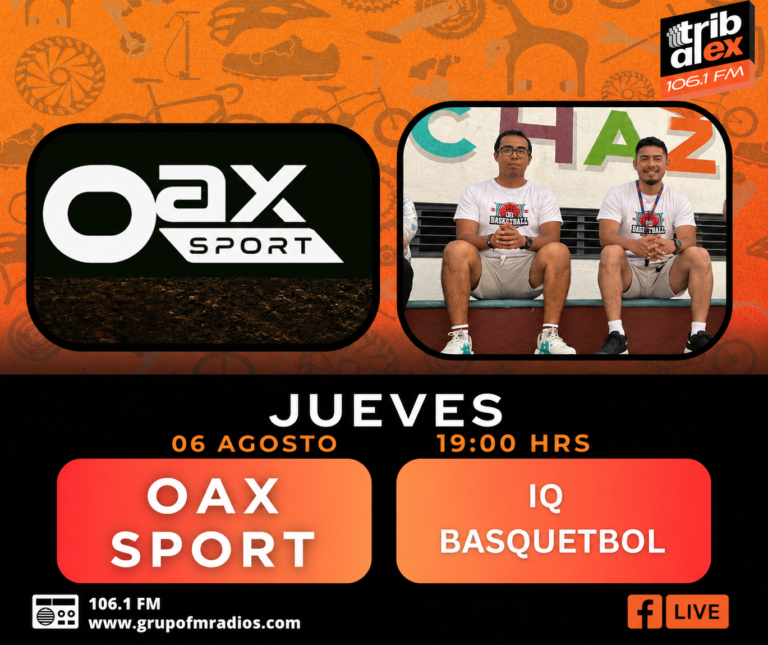

Original language: Spanish (radio segment on Tribu al Extremo, 106.1 FM).
By Juan Zurita Victoria, MBA
Oax Sport. Athlete Support and Programs.
This blog series
This post is part of Oax Sport Thursdays (Jueves de Oax Sport), our written series based on selected Tribu al Extremo broadcasts on 106.1 FM.
Oax Sport transcribes and publishes selected broadcasts. Not every broadcast is transcribed, and not every transcript is published, so gaps between written entries are normal.
Desiree joined this broadcast as co-host. She also took part in the July 30 segment on Oax Sport’s planned 2027 athlete sponsorship model.
Broadcast details
- Hosts: Juan Zurita Victoria and Desiree Dánae Ramírez García
- Guests: Josué Abraham Reyes Pacheco and Ángel Pérez
- Guest social media: Josué on Instagram and Ángel on Instagram
- Organization: IQ Basketball
- IQ Basketball online: Instagram and Facebook
- Sport: Basketball
- Show: Tribu al Extremo, 106.1 FM
- Segment: Oax Sport Thursdays
- Air date: Thursday, August 6, 2026
- Focus: player and coach development, basketball education, collaboration, and opportunities for young athletes
- Listen live: every Thursday, 7:00 p.m. to 8:00 p.m., Oaxaca time
Focus of the week
Josué Abraham Reyes Pacheco and Ángel Pérez joined us to explain IQ Basketball, a program they use to train players, support coaches, and bring basketball education to different parts of Oaxaca.
The discussion covered why IQ Basketball is different from a basketball club, why coaches need continued education, how training should change with a player’s age, what university coaches look for, and how collaboration can create more opportunities for athletes.
30-second recap
- IQ Basketball works with players and coaches rather than operating as a club that competes against other clubs.
- Players from different teams can attend IQ Basketball activities and continue training and competing with their own clubs.
- Josué Abraham Reyes Pacheco said the original IQ Basketball concept grew out of his graduate work in sports administration and management.
- The coaches said basketball development should also involve areas such as nutrition, psychology, and physiotherapy.
- IQ Basketball has worked with children, teenagers, university-age players, and coaches.
- Ángel Pérez said coaches must continue learning if they want to continue teaching.
- The broadcast also discussed university opportunities, scholarships, coachability, self-regulation, and what coaches look for when recruiting players.
What the coaches said on air
1. What IQ Basketball is
Josué described IQ Basketball as a program for the training, development, and promotion of basketball players and coaches.
He is from Ixtlán de Juárez in the Sierra Norte and said he has played basketball since he was eight years old. He studied sports training at UABJO and later completed graduate work in sports administration and management.
He said the IQ Basketball idea began during those graduate studies. One of his courses required him to develop a project that could sustain itself while contributing something useful to society.
Basketball was the natural starting point. Josué wanted to address a problem he had repeatedly seen: many people become coaches because they played the sport or because they are parents helping a team, but they may not have access to formal coach education.
He also saw talented players in communities and neighborhoods who needed more guidance and opportunities to continue learning.
Outside IQ Basketball, Josué said he works as a technical sports adviser in his municipality’s regiduría de deportes and as a physical education teacher.
2. Moving the project from paper to the court
Josué said the project remained on paper after graduate school until he decided to begin putting it into practice. He then discussed the idea with Ángel, and they started developing activities together.
Their first activity took place about three years before this broadcast. The coach they invited was Tomás Canizales, who has coached at national level. They said they have remained in contact with him as IQ Basketball continued developing activities.
They later organized activities in places including Guelatao, Ixtlán, the Huajuapan area, and Oaxaca.
Both coaches said building the program has required support from parents, coaches, sponsors, and other people willing to participate.
3. Why IQ Basketball is not a competing club
One of the main questions during the broadcast was whether IQ Basketball intended to create its own team and recruit players away from existing clubs.
Ángel said that is not the purpose.
Separately from IQ Basketball, Ángel coordinates Águilas Basketball Club, serves as head coach of the UABJO university team, and works as an assistant coach with Chapulines de Oaxaca. He also graduated from UABJO.
Players from Águilas Basketball Club or any other club can participate in an IQ Basketball camp or training activity and then continue playing with their regular team.
The same principle applies to coaches. IQ Basketball aims to share information that coaches can take back to their own teams rather than keeping that knowledge inside one organization.
Ángel explained that improving the general level of coaching and player preparation benefits basketball beyond a single club.
4. Why coach education matters
Both guests returned several times to the need for coaches to keep studying.
Ángel, translated from Spanish: “A person who stops learning loses the right to teach.”
For IQ Basketball, coach education can cover different stages of basketball. A coach working with young children needs different methods from someone working with university or high-level players.
Josué recalled advice from an experienced coach who described this as having two different mental settings. A child should not be treated as a smaller version of an adult. The language, objectives, exercises, expectations, and way a coach communicates all need to change with the athlete’s stage of development.
5. Basketball development extends beyond the court
Josué said IQ Basketball has also worked with professionals from areas connected to sport science.
He mentioned nutrition, psychology, and physiotherapy as examples. Players, coaches, parents, and other people around an athlete can all benefit from understanding how these areas affect training and development.
That approach reflects how the coaches see player preparation. Basketball skills matter, but a player’s physical, psychological, academic, and personal development also affects what happens on the court. For related youth development work, see Oax Sport’s Oaxaca Youth Sports Skills program.
6. Working with different ages
IQ Basketball works with two main groups: players and coaches.
Ángel said their player activities have included young children, teenagers, university players, and athletes around the under-25 level. Coach education naturally covers a wider age range because adults at different stages of their careers attend the sessions.
Josué said the objective with younger players is to follow a progression. What a six-year-old needs to learn is different from what a teenager or university player needs.
In his own coaching work, Josué said he was currently working mainly with children from about six years old through the early teenage years.
7. Sharing players, knowledge, and opportunities
The conversation also addressed tension between clubs and coaches.
The guests said some coaches worry that sending a player to another camp or training session could lead to that athlete leaving the club. They also discussed how players sometimes move repeatedly between teams for different competitions.
Josué, translated from Spanish: “Players do not belong to any coach.”
He said that does not eliminate loyalty or the importance of a player’s history with a coach and teammates. His point was that decisions should still consider what helps the player develop.
Both coaches said collaboration makes sense when teams share similar objectives and when the athlete’s development stays the priority.
8. Formation before competition
The coaches spoke about basketball as both competition and education.
Josué said coaches working with younger categories are forming people as well as basketball players. Ángel made a similar point when describing Águilas Basketball Club.
Águilas Basketball Club accepts players even when basketball is completely new to them. That can make immediate competition more difficult, especially when a teenager arrives with little previous experience, but access remains part of the club’s purpose.
Ángel said working again with young children also reminds him why he started coaching: basketball can be a place where children learn, play, and enjoy being on the court.
9. Scholarships and educational opportunities
Ángel said players who want a university route can start through UABJO, where he coaches.
At a previous IQ Basketball camp, the organizers announced tuition discounts for participants, and they identified players whose development stood out for larger discounts. Ángel said those opportunities came through Chapulines de Oaxaca’s own agreement with an educational institution, not through IQ Basketball.
He said scholarship candidates are assessed as people as well as players. Willingness to study, accept coaching, and take responsibility matter alongside basketball ability.
Interview in text
10. What makes IQ Basketball different from a club?
Q (Desiree): What makes IQ Basketball different from Águilas Basketball Club and from other basketball clubs?
A (Ángel): Águilas Basketball Club is my club. I coordinate it, and its main purpose is player formation and taking players to competitions. I am also head coach of the UABJO university team and an assistant coach with Chapulines de Oaxaca. Those roles are separate from IQ Basketball. When IQ Basketball runs a camp, it is open to players from different clubs and schools. They do not have to belong to Águilas Basketball Club or UABJO. They can attend the activity and then continue with their own teams.
11. Why would a coach refuse to collaborate?
Q (Desiree): Why do you think a coach would refuse to share their work or collaborate? In my own experience as a player, I have been told not to attend a camp because of who was running it.
A (Josué): I think, in the end, it is fear of losing what they have already built. Many coaches live from the name their club or academy has, and that work is valid. But players do not belong to any coach. That does not mean there is no process or loyalty. A player can recognize the club, teammates, and coach who helped them grow. When teams need to join forces so children can play, that can be healthy if the coaches share a similar way of working and have a clear objective. Our work with younger categories is to form people, using basketball as a tool.
12. What does a university coach look for?
Q (Desiree): When a young player is looking for a university opportunity, what does a university coach look for at tryouts or in conversations with the player?
A (Ángel): It depends on each coach. About a year earlier, I was in Veracruz and spoke with staff from UPAEP about a player I had brought to the event. During a game, the pressure got to her and I sat her on the bench for a while so she could settle down. The staff told me she was a very good player, but they would not have taken her because the first thing they look for is self-regulation. After that, they look at basketball level, academics, whether the player accepts coaching, and what the team needs at that moment. A coach may need a defensive player, a scorer, a bigger player, or a point guard.
What is next
Josué said one of the next steps for IQ Basketball was to give the project a more formal structure. He believed that could help the program seek more private support and reduce some of the costs faced by players and coaches who attend its activities.
The coaches also said they were preparing future basketball activities and wanted to continue working with coaches who have experience in specific areas of the sport. Ángel said IQ Basketball will announce its next event through its social media accounts. The August 6 broadcast confirmed no dates.
What Juan said about Oax Sport support
Near the end of the broadcast, I explained how Oax Sport’s athlete-support work was also changing.
I said Oax Sport had started mainly with athletics and was expanding its work to athletes from other sports. I also described our plan to select individual athletes for a more structured support model.
That expansion is already on record. Oax Sport has supported the Halcones CECAFID women’s basketball team with uniforms and other resources.
Possible support discussed on air included transportation, lodging, food, supplements, training equipment, shoes, uniforms, and other things an athlete needs to compete.
I said at the time that we expected to begin receiving applications in the following weeks and that coaches or other people in the sports community could also refer athletes who might need support.
This was an announced plan on August 6, not a statement that applications were already open. The July 30 Oax Sport Thursdays post linked above gives more background on the planned 2027 athlete sponsorship model. Readers can also review Oax Sport’s supported athletes and teams.
Quick Q&A for players, families, and coaches
Does a player have to leave their club to attend an IQ Basketball activity?
No. The coaches said IQ Basketball activities are open to players from different clubs, and those athletes can continue competing with their regular teams.
Is IQ Basketball itself a basketball club?
No. The guests described IQ Basketball as a player and coach development program. Ángel’s work with Águilas Basketball Club, UABJO, and Chapulines de Oaxaca is separate from IQ Basketball.
What do university basketball coaches look for besides skill?
The broadcast discussed self-regulation, willingness to accept coaching, academic commitment, adaptability, behavior, and whether a player’s abilities fit the specific needs of a team.
Why does IQ Basketball include coach education?
The guests said coaches need continued training and must adapt their methods to the age and level of the athletes they work with.
How you can help
Oax Sport backs athletes in Oaxaca with direct support and fundraising campaigns, across athletics and other sports.
You can make a general donation, review our current fundraisers, or contact us about athlete support, referrals, or collaboration.
Transparency
Statements about IQ Basketball, its activities, scholarship opportunities, and future plans in this article come from the August 6 broadcast and are reported as the coaches described them on air.
Oax Sport Inc. is a 501(c)(3) nonprofit (EIN: 86-3407818). Oax Sport A.C. is a registered Mexican nonprofit (RFC: OSP-230216-SG0). Contact us for receipts or tax documentation.
Listen every Thursday
Oax Sport Thursdays on Tribu al Extremo (106.1 FM) airs every Thursday, 7:00 p.m. to 8:00 p.m., Oaxaca time. Follow Tribu al Extremo on Facebook.
What would help a young basketball player or coach in Oaxaca keep learning without leaving their own club or community?
Last updated: September 2, 2026
Discover more from Oax Sport
Subscribe to get the latest posts sent to your email.