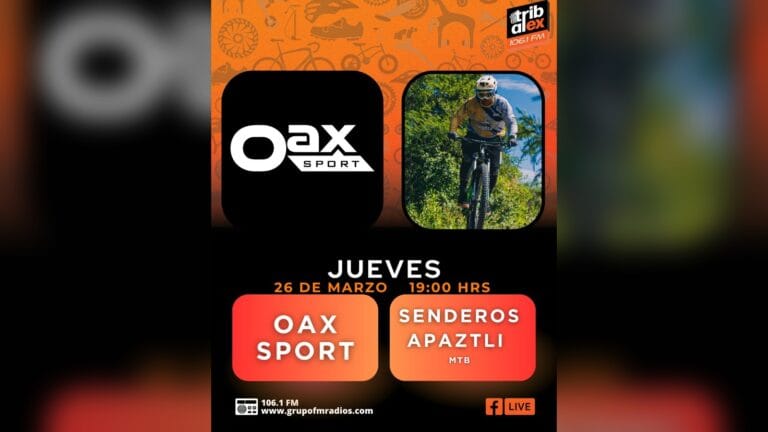

Original language: Spanish (radio segment on Tribu al Extremo, 106.1 FM).
By Juan Zurita Victoria, MBA
Oax Sport. Athlete Support and Programs.
Report also available in Spanish and French.
This blog series
Jueves de Oax Sport is our weekly space on Tribu al Extremo (106.1 FM). We use this segment to talk about sport in Oaxaca through athletes, coaches, teams, community projects and the people who support local sport.
Previous episodes: launch episode, Jazmín Cruz, Emily Barrera, Shunca Biani, Yedany González and Jorge Velasco.
Episode details
- Host and text: Juan Zurita Victoria, MBA
- Guest: Luis Manuel Santiago Olivera
- Project: Senderos Apaztli MTB
- Community: Magdalena Apazco
- Project social media: Instagram and Facebook
- Show: Tribu al Extremo (106.1 FM)
- Segment: Jueves de Oax Sport
- Air date: Thursday, March 26, 2026
- Focus: mountain biking, community trails, youth, recreational sport and volunteer trail work in Magdalena Apazco
- Listen live: every Thursday, 7:00 p.m. to 8:00 p.m., Oaxaca time, through Tribu al Extremo on Facebook.
Focus of the week
Focus: Senderos Apaztli MTB and the community work behind building mountain bike spaces in Magdalena Apazco.
- Luis talked about how he first connected with cycling and mountain biking.
- He explained why Senderos Apaztli MTB grew from a real need: safer, closer and more suitable spaces for mountain biking.
- He described the physical work behind clearing trails, carrying tools, building jumps and maintaining the routes.
- He shared how some people did not understand the project at first, but more riders and young people have slowly joined.
- This episode did not cover a specific Oax Sport athlete support case.
30-second recap
- Luis Manuel Santiago Olivera is from Magdalena Apazco and graduated from the Faculty of Physical Culture and Sport at UABJO.
- His project, Senderos Apaztli MTB, aims to promote mountain biking inside his community.
- The project started because Luis and his friends had to leave town or ride on roads to find more demanding trails.
- Building and maintaining trails takes hard physical work, technical knowledge, steady maintenance and support from others.
- Luis explained that the name Apaztli connects the project to Magdalena Apazco and to the idea of creating trails to share.
- The project now organizes community rides and wants to involve more young people, cyclists and people interested in outdoor activity.
- The conversation showed how a local project can create sport spaces where none existed before.
Interview in text
1. Luis, Magdalena Apazco and the start of mountain biking
Q (Juan): Luis, tell us a little about yourself. What is your full name, where are you from and what are you working on?
A (Luis): Hi to everyone watching and listening. My name is Luis Manuel Santiago Olivera. I am from Magdalena Apazco. I graduated from the Faculty of Physical Culture and Sport at UABJO, and right now I am working on Senderos Apaztli, a project that seeks to promote mountain biking inside my community.
Q (Juan): What was it like growing up in Magdalena Apazco, and what does your community mean to you?
A (Luis): Magdalena Apazco is, in my view, a very beautiful town. Since I was little, the environment has felt very interesting and welcoming. The town is peaceful. I think it has a lot of potential for sport. I am talking about more than mountain biking. In general, I think this is a town with a lot of potential.
Juan and Luis mentioned several local places in Magdalena Apazco, including the dam, the spring, the Talán mines and the quarries.
Q (Juan): Do you remember the first time you got on a bike? How did this love for mountain biking begin?
A (Luis): My first time on a bike was probably when I was around 4 years old. Back then, you are just a kid and you do not really understand all the possibilities that recreation and sport can give you.
A (Luis): The real love for this sport started when I was in high school. I think the beautiful part of sport is when you begin without knowing exactly what you want. You do not notice it at first. Then the sport catches you. You start liking it more and more. You want to go out more often, spend more hours on the bike and visit more places.
A (Luis): When I bought my first bike as an older rider, I said I wanted a bike that could work for the street, the road and the mountain. I did not know that this love and passion for the sport would grow to the level it has reached now.
2. Why Senderos Apaztli MTB started
Q (Juan): How did the idea for Senderos Apaztli begin?
A (Luis): At first, I did not intend for it to reach this level. The idea came from a need. We needed proper and demanding spaces to practice mountain biking.
A (Luis): Before, I used to go out with my friends. We were four or five. We had to look in other towns or communities for more demanding trails. Sometimes we went to San Miguel, Las Guacamayas, Huitzo or even El Fortín. That meant riding on roads, and riding on roads carries a high risk.
A (Luis): Senderos Apaztli came from wanting proper cycling spaces inside the community. Not only wide roads, but trails, narrow paths, a few jumps, curves and berms. Those kinds of builds slowly gave life to what is now Senderos Apaztli.
3. What the name Senderos Apaztli means
Q (Juan): What does the name mean? Why did you choose Senderos Apaztli?
A (Luis): At first, I created an Instagram profile where I uploaded what I was doing in the hills, like jumps or trail cleaning. Then I reached a point where I thought it looked a little selfish to say that I was the one doing it.
A (Luis): Something I always like to say is that everything we create, we create it to share it. So I decided to change the name to Senderos Apaztli.
A (Luis): Senderos represents the small trails and everything in the mountain. Apaztli comes from Magdalena Apazco. In the end, I was working on the trails, and the name became Senderos Apaztli. Then MTB refers to mountain biking.
4. When people did not understand the project
Q (Juan): At the beginning, did people understand what you were doing?
A (Luis): It was difficult. Imagine someone walking calmly down the street and suddenly seeing a young guy going up the hill with a bike, carrying a pick, a shovel and a machete in his backpack. People would look at me like, what is he going to do?
A (Luis): Fortunately, the project has grown. Now people are a little more open. They understand what this sport is about.
A (Luis): There were times when I would build jumps, go back the next day to test them, and they were destroyed. That happened two or three times. The last time, I said I was not going to continue. Maybe people did not like it.
A (Luis): I paused the construction and trail cleaning for two or three months. But I felt like something was missing. Part of me wanted to come back and try again. From there, the project grew.
5. The first trail and “la desarma fierros”
Q (Juan): Do you remember the first trail you worked on?
A (Luis): Yes. We started as a group. We had planned to ride in the afternoon. Two of the guys went ahead, and after a few minutes they called me and said, Chino, bring a shovel. I was confused, but I grabbed my backpack, carried the shovel and went up.
A (Luis): It was Trail 1, which comes out of Camino Ancho de Talán. It is a technical trail with some slope. At that time, for us, it felt very technical.
A (Luis): We gave it a funny name. One friend called it “la desarma fierros,” because you went down with your bike, your “fierro,” bouncing everywhere, and the bike felt like it was falling apart. Even now, I still talk with that friend and he asks me, how is “la desarma fierros” going?
6. The hard work and technical knowledge behind a trail
Q (Juan): How difficult is it to create a trail, maintain it and build features the right way?
A (Luis): It is a very difficult task. One of the hardest parts is clearing a trail. The advantage we had was that some lines in town were already marked as old paths. Older people knew them, but they were not used much anymore.
A (Luis): Having the line already marked is a major advantage. It is not the same to have an idea of the full line, from beginning to end, as it is to have no idea where to start, where it will end or where to make the curves.
A (Luis): But that does not make it easy. In Magdalena, the ground is very hard. There are very few sections with soft dirt. Sometimes, besides the hoe, you need to carry a pick because it creates more impact on the ground. Carrying the tools and taking them up to the start or end of the line is a lot of work.
A (Luis): Also, in Magdalena there is almost no shade. The vegetation is mostly brush and shrubs. You can start cleaning or building a jump at 7:00 a.m., and by 8:00 or 9:00 it already feels extremely hot.
A (Luis): Many people think it is only going up there, shoveling, digging here and there, moving dirt and done. But it is not. I have been fortunate that riders from outside the town, with more experience, have come to support work days and share knowledge.
A (Luis): When you build any kind of spot or feature, you need to think about the rider who is just starting and also the more experienced rider. If you build a jump, you should also think about who needs an alternate line to avoid that jump.
A (Luis): Building a jump has its science. It is not just making a small ramp. A double jump has one ramp that sends you up and another opposite ramp where you land, so the landing is smooth.
A (Luis): You need to calculate how far you will fly, the speed you will carry and where the landing should go. A takeoff needs a smooth transition from the ground to the lip. It also depends on whether you want the jump to send you up or carry you forward with speed.
A (Luis): Over time, I understood that the goal is to make a fluid line. Before, I built jumps where I found dirt that was somewhat soft. Later I said, no, this needs to be a complete line.
7. Seeing the idea become real
Q (Juan): Before, you used to say that one day you wanted to build big jumps in Magdalena. Now you are doing it. What do you feel when you see people enjoying that work?
A (Luis): I feel satisfied and also unsatisfied. Satisfied because you look back and see where you came from, what did not exist before and what exists now. That fills you with satisfaction.
A (Luis): I also feel very grateful to all the people who have supported me. Without them, nothing that exists now would exist, or the process would have been much slower.
A (Luis): I feel happy because more people are looking at Magdalena. That is one of the goals of Senderos Apaztli. But I also feel that a lot of work is still missing. That empty space that still needs to be filled is the reason I do not stop.
Luis also shared one clear example of how much the project has changed. What began as small jumps of about 1 to 2 meters has grown into a line with jumps of about 3 to 4 meters. One of the largest features is known as “el tractor,” built with tractor tires packed with dirt.
8. The people behind the project
Q (Juan): What people have been essential to the project?
A (Luis): First, I want to thank the group. Christopher, Cristóbal, Javier and Sebastián were people who were there from the beginning. Like in life, everyone starts to build their own way of life, because of work, university or other reasons, but we stay in communication.
A (Luis): There were also people who came to the 2023 event and stayed involved. Cervantes, the engineer Alexis and Eliel were among the first people from outside to believe in the project and support it.
A (Luis): From there, more people started joining. Dylan, who comes from BMX, has also been part of the recent work. With him and his crew, we have been building the latest jumps and spots.
Senderos Apaztli MTB grows because riders, friends and volunteers see value in the work and choose to give time, tools and energy.
9. Community impact, youth and community rides
Q (Juan): How has the community in Magdalena Apazco reacted? Have young people started to come closer to the project?
A (Luis): It has had a big impact. It has been difficult because the community is peaceful, but sometimes people are closed to sports that are not the usual ones. Football and basketball do not look strange, but people may look at you strangely for running in the hills, or at me for riding a bike.
A (Luis): It has been difficult to create awareness about all the work and about what this sport really is. Before, maybe people thought you were going out on your bike to waste time, not to actually train.
A (Luis): Right now, my priority is to focus more on young people. We are looking for ways to integrate the community, although it is not an easy sport. Buying a bike is an investment. Then comes maintenance, protective gear and everything else. But we are working on strategies to bring the community in.
Q (Juan): You have started a different dynamic with community rides. How do those work?
A (Luis): This year, we want to try different strategies to bring people in. I started with community rides. About 15 days ago, I organized the first ride, and everything went well.
A (Luis): Even though not many people from the community joined, people from outside joined. That is also part of it. The point is to bring people to the town. People from outside can also motivate the people who live here.
A (Luis): I want to invite everyone who practices cycling or wants to start. If it is possible for them, they can join the community rides we organize as Senderos Apaztli.
A (Luis): The idea is to organize them at least every 15 days, depending on the situation and personal possibilities. They are recreational rides. We want to encourage connection, physical activity and for people to get to know the town, the dam, the salt areas, the spring and other places.
10. What the project has taught Luis
Q (Juan): What has this project taught you personally?
A (Luis): That is a big question. The most important thing this project has taught me is that, despite all the obstacles, if something motivates you and you are passionate about it, you should keep following it.
A (Luis): There was a time when I would go, build everything, and the next day it was already destroyed. That requires mental endurance. It also taught me to take initiative and say: I am going to do this because I want to do it and I can.
A (Luis): It is valid to ask for support because this is not easy. But if people have the initiative, motivation and desire, they should go ahead. If they want to go out with their shovel and pick, even if people look at them strangely, they should do it. In the end, that is what this is about.
What is next
Senderos Apaztli MTB wants to keep organizing community rides, bring more people to Magdalena Apazco and motivate young people from the community to practice mountain biking or join outdoor activities.
The project will also continue to need hands, time and participation. Clearing trails, building lines, maintaining spaces and caring for the land require consistency. Luis was clear: the progress is visible, but there is still a lot to do.
Quick Q&A for athletes, riders and readers
What does this episode show about community sport?
It shows that a project can begin with a few people and grow through consistency. It also shows that communities can create their own sport spaces through organization and shared work.
Why do local trails matter?
They reduce the need to ride on roads and allow people to practice closer to home. They also bring more people to the community and its outdoor spaces.
What does it take to build an MTB trail?
It takes physical work, tools, land reading, maintenance and technical knowledge. Luis explained that jumps, curves, berms and alternate lines need to consider riders at different levels.
How can someone support the project?
They can follow Senderos Apaztli MTB on Instagram, join community rides, participate in trail work days or contact the project through Facebook.
How you can support today
Oax Sport runs an active fundraising campaign for Senderos Apaztli MTB.
- Donate to the Senderos Apaztli MTB campaign
- Learn more about Senderos Apaztli MTB
- Follow Senderos Apaztli MTB on Instagram
- Follow Senderos Apaztli MTB on Facebook
- Support active Oax Sport fundraisers
- Donate to Oax Sport
- Contact Oax Sport
Transparency
Oax Sport Inc. is a 501(c)(3) nonprofit (EIN: 86-3407818). Oax Sport A.C. is a registered Mexican nonprofit (RFC: OSP230216SG0). Contact us for receipts or tax documentation.
Listen every Thursday
Listen to Tribu al Extremo on 106.1 FM every Thursday, 7:00 p.m. to 8:00 p.m., Oaxaca time. You can also follow the broadcast through Tribu al Extremo on Facebook.
What outdoor space in your community could become a place for sport, movement and connection?
Last updated: June 2, 2026
Discover more from Oax Sport
Subscribe to get the latest posts sent to your email.