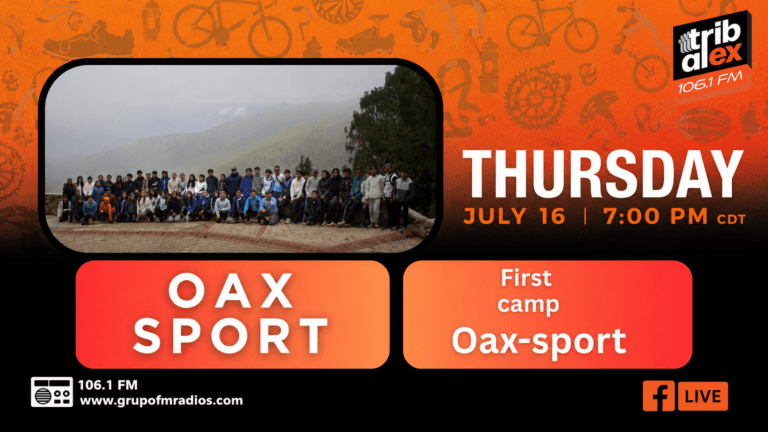

Original language: Spanish (radio segment on Tribu al Extremo, 106.1 FM).
By Juan Zurita Victoria, MBA
Oax Sport. Athlete Support and Programs.
This blog series
This post is part of Oax Sport Thursdays (Jueves de Oax Sport), our written series based on selected Tribu al Extremo broadcasts on 106.1 FM.
We transcribe and publish selected episodes. Not every broadcast becomes a written post, so gaps between published entries are expected.
A previous published entry, Episode 11, covered the camp before it took place and discussed Oax Sport’s athlete-support planning for 2027.
Broadcast details
- Host: Juan Zurita Victoria
- Guest: Desirée Ramírez
- Guest social media: Instagram and TikTok
- Show: Tribu al Extremo, 106.1 FM
- Segment: Oax Sport Thursdays
- Air date: July 16, 2026
- Focus: A first-hand recap of the Oax Sport–Titanes 2026 Athletics Camp
- Listen live: every Thursday, 7:00 p.m. to 8:00 p.m., Oaxaca time
Focus of the week
Desirée joined me to look back at the Oax Sport–Titanes 2026 Athletics Camp after four days of training and education in Oaxaca de Juárez and Ixtepeji.
We talked about how the camp came together, the short planning period, the work of coaches and specialists, athlete reactions, transportation and venue logistics, and what we learned from track, pool, strength, recovery, and mountain sessions.
30-second recap
- Jeanine Bourcier Holmlund agreed to join the camp within days of our invitation, leaving us roughly one month to organize the program.
- The camp included running mechanics, coordination work, sports psychology, aquajogging, altitude training, nutrition, strength work, and physical recovery.
- Desirée participated in several sessions and shared a first-hand athlete perspective during the broadcast.
- Young athletes trained in Oaxaca and Ixtepeji alongside coaches, students, and participants from other clubs and institutions.
- Transportation, facilities, volunteer work, specialists, coaches, and contributed goods all helped us run the four-day program.
- Oax Sport later documented 60 athletes, coaches, and students from 10 clubs and institutions in the full camp report.
What Juan said on air
1. How the camp idea developed
I explained that the idea grew from earlier work with Titanes and Coach Uber Clain Herrera Aquino.
During an earlier Titanes camp, Jeanine Bourcier Holmlund approached the group after seeing athletes and coaches training. We stayed in contact while she was in Oaxaca and later invited her to return for the July 2026 camp.
We wanted athletes and coaches to work with methods and training settings that they did not regularly have access to.
2. Roughly one month to organize the camp
Jeanine responded quickly when I contacted her about returning to Oaxaca. Within days, she confirmed her participation and bought her flights.
That left Coach Uber Clain Herrera Aquino and me with roughly one month to work through registration, transportation, venues, schedules, specialists, equipment, and participant logistics.
Juan, translated from Spanish: “We had practically one month to organize everything.”
3. Day 1 combined technique, psychology, and pool work
The camp opened at Ciudad Universitaria with running mechanics, coordination, hurdle work, and technical exercises.
Jeanine also brought sports-nutrition products to Oaxaca. The later Oax Sport camp record confirms that she secured and transported donated GU products and helped distribute them during the camp.
Dr. Emilio Nocedal Rojas presented “The Mind of a Champion.” We discussed how athletes need to train with a purpose instead of completing sessions without thinking about what they need to improve.
The afternoon moved to the 5 Señores swimming pool for aquajogging and other exercises in the water. For several participants, this was their first experience using a pool for running-specific conditioning and reduced-impact work.
4. Training with a specific purpose
A large part of our discussion focused on conscious training.
I talked about athletes going into a session or competition with a specific objective. An athlete may work on a start, acceleration, technique, rhythm, or another part of performance even when a personal best is not the goal that day.
Desirée connected this idea to her own years in basketball. She described how repeated work on basic skills can feel routine when athletes are young, but those repetitions become part of long-term development.
5. The first altitude session in Ixtepeji
The next major challenge was taking the group to Ixtepeji.
We had transportation to organize, cold weather to prepare for, and athletes with different training needs. Distance runners and sprinters completed different work in the mountains.
I ran with the middle-distance and distance group toward the lookout area. Other participants worked on short, hard uphill efforts.
We also saw how much the younger athletes enjoyed getting outside their normal training environment.
Desirée, translated from Spanish: “I saw them giving everything in every sprint, in every repetition.”
6. Nutrition, hydration, and strength
Another day began with track work at Parque Primavera.
Nutritionist Elisa Reyes Valdés then spoke with participants about food, hydration, recovery, and the use of sports-nutrition products.
We discussed basic habits that athletes sometimes overlook, including arriving at training with enough water and understanding how nutrition fits the demands of training and competition.
The program later moved to the Hermanos Flores Magón Sports Complex for strength and physical-preparation work.
7. Rain, mountains, recovery, and the closing day
The final day returned to Ixtepeji.
This time the group faced rain, fog, cold conditions, and demanding climbs. Athletes completed another mountain session before returning for physical recovery.
Daniel Legaría and his physical-therapy team worked with participants after the training load of the previous days.
Jeanine had also brought footwear, clothing, books, and other materials. Participants received several items during the closing activities.
Interview in text
8. How the first morning started
Q (Juan): What did we do first? I do not remember whether we handed out the gels first or at the end.
A (Desirée): We started with a normal warm-up. First mobility, then some plyometrics, jogging, and finally the stronger coordination work. We worked with the ladder and hurdles, including hip mobility. It started calmly and also gave everyone time to get to know one another.
9. What the sprint group did in the mountains
Q (Juan): You stayed with the sprinter group, right? How was it there for you?
A (Desirée): Because my background is basketball, I thought the speed work would also help me. We worked on uphill power. We did 10 one-minute repetitions, running hard for as far as we could. It was demanding, especially at altitude, and it required both physical effort and mental control.
10. The final mountain session
Q (Juan): You were able to go on the final mountain session too, right?
A (Desirée): I went with the distance group and worked at my own pace. The rain and the mountain changed the experience completely. The climbs were demanding, but being outside and working with the group made the session different from our usual training.
Update after the broadcast
Update, August 11, 2026. Oax Sport’s current full camp report records 60 athletes, coaches, and students from 10 clubs and institutions across the official four-day camp from July 9 to 12.
The report records a minimum documented project value of US$8,782. It separates cash resources, contributed goods, estimated pro bono professional services, and Jeanine Bourcier Holmlund’s unreimbursed travel and lodging. It also records her separate pre-camp university lecture outside the official four-day camp.
Who supported the camp
- Jeanine Bourcier Holmlund: guest coaching, workshops, practical sessions, donated GU product coordination and transport, and personally contributed equipment and educational materials.
- Coach Uber Clain Herrera Aquino and Titanes: recruitment, planning, venue coordination, logistics, communication, participant support, and practical sessions.
- Dr. Emilio Nocedal Rojas: sports-psychology session.
- Elisa Reyes Valdés: sports-nutrition session.
- Daniel Legaría: physical therapy and recovery.
- Braulio Jiménez Hernandez: photography across the camp.
- Antorcha Campesina Oaxaca: transportation support between camp locations.
- Universidad Autónoma “Benito Juárez” de Oaxaca: space for training and educational activities.
- Instituto del Deporte del Estado de Oaxaca: space and gym facilities at the Hermanos Flores Magón Sports Complex.
What is next
I closed the broadcast by thanking the athletes, coaches, students, specialists, volunteers, and organizations that took part.
We were already discussing future camps, but we did not announce a date or program for the next one during this broadcast.
Quick Q&A for athletes, families, and donors
Was this only a running camp?
No. The program combined athletics training with sports psychology, nutrition, aquajogging, strength work, coach education, and physical recovery.
Did Desirée participate in the camp?
Yes. She took part in several sessions and joined the July 16 broadcast to describe the camp from an athlete’s perspective.
How was the camp funded and supported?
Oax Sport’s later financial record documents registration fees, Oax Sport funds, contributed goods, pro bono professional services, institutional facilities, volunteer work, and Jeanine Bourcier Holmlund’s unreimbursed travel and lodging.
Where is the complete camp record?
The full Oax Sport camp report linked above contains the participant totals, daily program, institutional credits, contributed goods, and financial record.
Transparency
The first-hand camp observations in this post come from the July 16 radio broadcast. Participant totals, financial figures, and other later-confirmed details come from Oax Sport’s post-camp records.
Oax Sport Inc. is a 501(c)(3) nonprofit (EIN: 86-3407818). Oax Sport A.C. is a registered Mexican nonprofit (RFC: OSP-230216-SG0). Contact us for receipts or tax documentation.
Listen every Thursday
Listen to Tribu al Extremo on 106.1 FM every Thursday, 7:00 p.m. to 8:00 p.m., Oaxaca time.
Follow Tribu al Extremo on Facebook.
Which part of the camp would you most like to see repeated in a future Oax Sport–Titanes program?
Last updated: October 15, 2026
Discover more from Oax Sport
Subscribe to get the latest posts sent to your email.