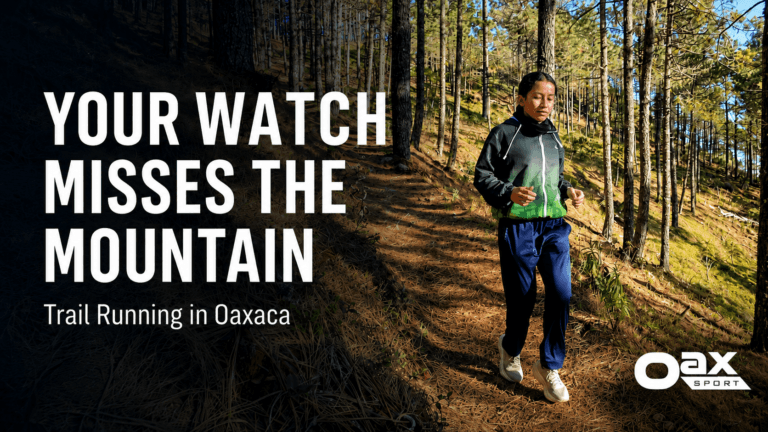

By Eddi Pérez Silva, Founder, Board Member, and Athletic Director, Oax Sport
A watch can give you useful numbers. I use those numbers with athletes. Pace, heart rate, elevation, recovery, and training load all tell part of the story.
But anyone who trains in Oaxaca knows the mountain keeps part of the story for itself.
As Niki Micallef sets out in his Born on the Trail analysis, most watches estimate VO₂ max and threshold from road-style patterns. They also show pace, heart rate, elevation, and recovery, which matter, but only when a coach reads them with the terrain in mind.
A climb in the Sierra Norte, a rocky descent near the city, a hot section after 2 hours, or a bad pacing decision early in the run can change everything. The watch may still show data, but it may not understand what the runner is really dealing with.
This article is a local coaching reflection built from 3 things: Niki Micallef’s Born on the Trail analysis, the research sources cited in that article, and Oax Sport’s own trail context in Oaxaca. The science explains why watch predictions often struggle on trail. Oaxaca routes show what that looks like in practice.
Micallef’s article, “Your Watch Doesn’t Understand Trail Running Performance,” was published on July 4, 2026. It reviews why road-running predictors work better on flat courses than on trail, then looks at the research behind uphill running, pacing, and fatigue resistance. (bornonthetrail.substack.com)
For Oax Sport, the question is practical: how should runners in Oaxaca train when the ground, altitude, and effort keep changing?
For more local context, Oax Sport’s trail running guide for Oaxaca explains how terrain, altitude, and route choice shape the running experience here.
A route tells the story
In Oaxaca, running culture is tied to hills.
Some athletes train on paved climbs near the city. Others run dirt roads, forest trails, rocky paths, dry hillsides, and long mountain routes. A runner can leave the city in the morning and face a different kind of effort within a short distance.
Oax Sport’s guided Sierra Norte Trail Run reaches 2,800 to 3,200 meters above sea level, according to the route page. (oaxsport.org) The La Cumbre Ixtepeji TCX route we reviewed shows a longer 20 km loop that starts near 2,722 meters and reaches about 3,269 meters around km 10.
That difference matters. The guided experience and the full loop do not ask the same thing from the runner, but both show the same coaching point: altitude and climbing change the meaning of pace.
The La Cumbre Ixtepeji loop does not feel like one long climb. It rises in steps. The first section climbs from the start to about km 4. Another rise comes around km 6 to 7.5. Then the route pushes again from about km 8 to km 10, where the high point arrives.
A runner can look controlled early and still lose rhythm on that last climb. The heart rate may look reasonable, but the legs have already paid for the first half. After that, the descent still asks for fresh legs and clear decisions.
That is why a 5:00 min/km pace on a flat road says one thing, and a 5:00 min/km pace on a rocky climb at altitude says something else. Even heart rate needs context. Heat, dehydration, sleep, stress, and fatigue can all change the response.
A runner who trains only by road pace can arrive on trail with good fitness and still struggle. I have seen that happen. The legs may be strong on paper, but the terrain asks different questions.
What the road model gets right
The classic model of endurance performance usually starts with 3 variables:
- VO₂ max.
- Lactate threshold.
- Running economy.
Michael Joyner’s 1991 work modeled marathon performance using these physiological factors. The current concept is that VO₂ max sets the upper limit for aerobic metabolism, lactate threshold relates to the fraction of VO₂ max that can be sustained, and running economy affects the speed a runner can hold at that effort. (pubmed.ncbi.nlm.nih.gov)
A 2026 Sports Medicine study by Mougin and colleagues tested 495 runners and 393 cyclists. The authors found that maximal oxygen uptake contributed most to performance proxies, followed by economy, while fractional use of VO₂ max contributed less in a mixed-ability group. (link.springer.com)
That makes sense on the road. If the course is flat and the surface is stable, the model has room to work. You can compare athletes more fairly because the ground does not change much under their feet.
Trail running asks for more context: surface, slope, altitude, time on feet, and how the athlete moves after fatigue begins.
Why road fitness does not fully explain trail performance
As Micallef’s article explains, trail running still uses VO₂ max, threshold, and economy. It just changes how those qualities appear.
Testing trail runners with flat, road-style protocols misses the principle of specificity. On trail, the runner has to climb, descend, brake, stabilize, shorten or lengthen the stride, choose a clean line, and keep moving when the legs are already tired. A flat treadmill test cannot measure all of that.
Micallef reports that De Waal and colleagues’ systematic review covered 7 studies with 129 participants. In that review, velocity at VO₂ max was the strongest predictor of trail performance, with a correlation of -0.68. Running economy was the weakest of the main physiological predictors, with a correlation of -0.31. (bornonthetrail.substack.com)
As a coach, that matches what I see in Oaxaca.
One runner may look smooth on the road and lose time once the climb starts. Another may have less road speed but move better uphill because the body is used to that effort. A third runner may climb well, then lose minutes on the descent because the legs cannot handle the braking. Pace alone does not measure trail skill.
Uphill running changes the race
One of the strongest trail-performance findings comes from De Waal, Jacobs, and Lamberts’ study of the 2021 Ultra Trail Cape Town 100 km.
The study analyzed 50 male finishers using Strava data from 46 course segments. The route had more than 5,000 meters of elevation gain. The authors compared uphill, downhill, and level running with overall performance. (eprints.glos.ac.uk)
Their result was clear: uphill running had the strongest relationship with overall performance. Uphill performance had a correlation of 0.826 with overall performance, while level running and downhill running showed weaker relationships. (eprints.glos.ac.uk)
Climbs take time, expose weakness, and punish poor pacing.
In Oaxaca, that lesson is easy to understand. On routes like Guacamaya Trail, climbs define the day. A runner who pushes early because the watch says the effort looks fine can pay later with heavy legs, poor descending, and slower decisions.
The climb often tells the truth.
Descending is a skill
On trail, downhill costs time and muscle.
A rocky descent is work. The quadriceps absorb force with every step, especially when the slope gets steep. Ankles, hips, and core have to stabilize the body while the runner reads the ground ahead.
When fatigue arrives, the eyes slow down, the stride gets heavier, and one bad step can break rhythm.
That does not always show in a VO₂ max estimate.
A runner may have a strong engine and still lose time because descending causes too much muscular damage. In long trail races, that damage can shape the final third of the race.
For training in Oaxaca, I want athletes to learn 3 things:
- Climb with control.
- Descend with rhythm.
- Save enough strength to descend well late.
Many runners train the first two. Fewer train the third.
Altitude changes how effort feels
Oaxaca adds another layer: altitude.
Our Sierra Norte routes can reach 2,800 to 3,200 meters. (oaxsport.org) At those elevations, effort feels different. The same pace can feel harder. Recovery can take longer. Breathing can feel less controlled, especially for visitors or runners who usually train near sea level.
A watch may adjust some metrics for altitude, but it cannot fully read how an athlete handles the whole environment.
Altitude affects pacing, hydration, sleep, breathing rhythm, and decision-making. It can also affect confidence. A runner who starts too hard at altitude may spend the rest of the route trying to recover.
The coach has to teach the athlete to respect effort before pace.
Lactate works as fuel
Dr. Iñigo San Millán’s article on lactate explains that, at normal body pH, the correct term is lactate, and lactate acts as a circulating fuel rather than a dead-end waste product. (inigosanmillan.substack.com)
For trail runners, this matters because threshold work still has value. It teaches the body to hold a strong effort without breaking down too early. But threshold training has to fit the athlete and the course.
A flat threshold workout has value. Uphill threshold work has different value. For Oaxaca trail athletes, both can belong in the plan. The closer we get to a mountain race, the more the work needs to look like the race.
The fourth factor: fatigue resistance
Micallef frames the classic road model as a fresh-state view: what can a runner do before fatigue changes the body? He treats fatigue resistance as a fourth pillar, drawing on Andrew Jones’s work on physiological resilience, often called durability. Jones describes it as how well an athlete preserves performance characteristics under fatigue. (doi.org)
That idea fits trail running well.
A runner can have a strong VO₂ max test and still fade badly after long climbs. Another runner may not test as high but may lose less performance after 2 hours of effort. On trail, that second athlete can be very hard to beat.
For Oaxacan athletes, this is one reason long runs, progressive climbs, controlled descents, and strength work matter. The body has to keep moving well after fatigue begins, with enough quality left for the hardest part of the race.
What I would tell a Oaxaca trail runner
If an athlete asks me whether a watch prediction is useful, my answer is yes, but only as one small reference.
Build trail confidence from the work. A runner should know whether they can climb for a long time without pushing too hard too early. They should also know what happens after 90 minutes, 2 hours, or 3 hours, when form and judgment start to change.
Then I would ask the harder questions:
- Can you descend smoothly when your legs are tired?
- Can you eat and drink while moving?
- Can you adjust when heat, altitude, or terrain changes?
- Can you finish the final section with discipline?
Those answers matter more than the race predictor on your watch.
How to train for Oaxaca trails
For a runner preparing for Oaxaca terrain, I would build the week around these areas.
Aerobic base.
The athlete needs enough easy volume to handle time on feet. This supports recovery, climbing, and longer efforts.
Climbing strength.
Use sustained climbs, hill repeats, controlled hiking on steep grades, and gym work for calves, glutes, hamstrings, quadriceps, and trunk stability.
Descending skill.
Train downhill running gradually. Start with technique, then add volume. The athlete should learn rhythm, short contact, stable posture, and relaxed breathing.
Threshold work.
Use controlled efforts on flat ground and uphill. The goal is strong, repeatable work without turning every session into a race.
Long runs with terrain.
Long runs should match the event over time. For a mountain race, the athlete needs elevation, uneven ground, fueling practice, and late-run control.
Fatigue resistance.
Add some workouts where the athlete must run well after prior effort. This can be a climb late in a long run, a controlled descent after a sustained uphill, or steady running after strength fatigue. The dose has to be careful.
Pacing practice.
The athlete should learn when to hold back. On trail, patience often saves more time than aggression.
What I would track on Oaxaca trails
The watch still matters. I just want athletes to track the right things.
For Oaxaca trails, I would look at total elevation gain, time spent climbing, heart rate drift late in the run, and how well the runner descends after fatigue. I would also track fueling during efforts over 90 minutes.
Micallef makes a point I use with athletes: leg effort and breathing effort are separate signals. I ask athletes to track them separately. A runner may feel fine in the chest but heavy in the legs, or the opposite.
That detail matters on climbs and descents.
I also care about the finish. Starting fast is easy. Finishing controlled tells me more.
What the watch can still do well
I do not reject technology. Watches are useful.
A watch tracks load, heart rate, and elevation gain over time. Read across weeks, it can show patterns in sleep, recovery, and whether an athlete is doing too much or too little.
But the watch should serve the coach and athlete. It should not replace their judgment.
In Oaxaca, the best training decisions come from combining data with local knowledge: the route, the surface, the weather, the athlete’s history, and what the coach sees in movement. A watch records what happened, and a coach works out why.
Why this matters for Oax Sport
Oax Sport supports athletes from communities in Oaxaca where access to coaching, travel, gear, and competition opportunities is often limited. We take training seriously because good planning protects athletes and gives them a better chance to compete well.
Trail running in Oaxaca is part of that work. It connects athletes with land, community, discipline, and long-term development. It also gives visitors a direct way to run with local athletes and support the programs behind them.
You can learn more about Oax Sport’s leadership and volunteer team on our members page.
If you want to experience Oaxaca trails with Oax Sport, our guided routes include Sierra Norte and Guacamaya Trail. (oaxsport.org)
If you want to support athlete development in Oaxaca, you can donate to Oax Sport. You can also volunteer with Oax Sport if you want to contribute time, skills, or local support.
Legal and transparency
Oax Sport Inc. is a U.S. 501(c)(3) nonprofit. EIN: 86-3407818.
Oax Sport A.C. is a registered Mexican nonprofit based in Oaxaca, Mexico. RFC: OSP-230216-SG0.
Donations support athletes from underserved communities in Oaxaca, Mexico.
If you need a receipt or tax documentation, contact us and tell us whether you donated to Oax Sport Inc. in the United States or Oax Sport A.C. in Mexico.
Sources and further reading
The endurance model discussed here traces back to Michael Joyner’s work on marathon performance and later reviews on champion endurance athletes. (pubmed.ncbi.nlm.nih.gov)
The 2026 study by Mougin and colleagues tested 888 runners and cyclists and examined how VO₂ max, economy, and fractional use of VO₂ max contribute to endurance performance proxies. (link.springer.com)
The Ultra Trail Cape Town pacing analysis by De Waal, Jacobs, and Lamberts found uphill performance had the strongest relationship with overall 100 km trail performance. (eprints.glos.ac.uk)
San Millán’s lactate article explains why lactate should be understood as a fuel and active metabolic molecule, not as “lactic acid” waste. (inigosanmillan.substack.com)
Jones’ work on physiological resilience argues that endurance models need to account for how performance variables change under fatigue. (doi.org)
This Oax Sport post builds on Niki Micallef’s Born on the Trail article, “Your Watch Doesn’t Understand Trail Running Performance,” published July 4, 2026. (bornonthetrail.substack.com)
What does your watch miss most when you run Oaxaca’s trails?
Discover more from Oax Sport
Subscribe to get the latest posts sent to your email.