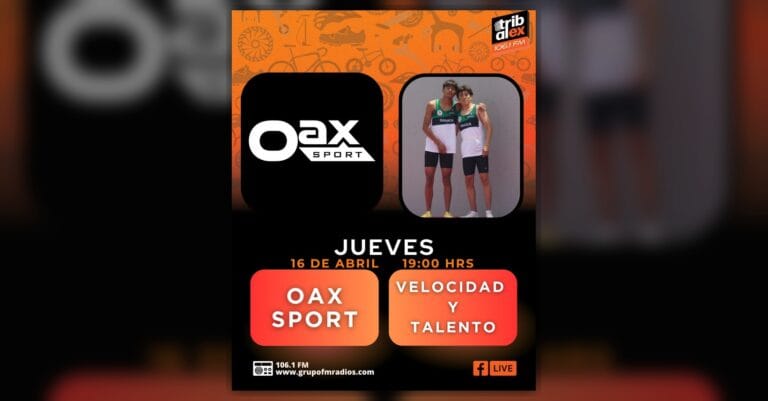

Original language: Spanish (radio segment on Tribu al Extremo, 106.1 FM).
By Juan Zurita Victoria, MBA
Oax Sport. Athlete Support and Programs.
Report also available in Spanish and French.
This blog series
This post is part of Oax Sport Thursdays on Tribu al Extremo (106.1 FM), a weekly space for sport, athletes, coaches, and community support in Oaxaca.
You can also read the previous episodes: Episode 0, Episode 1, Episode 2, Episode 3, Episode 4, Episode 5, Episode 6, Episode 7, and Episode 8.
Episode details
- Host and text: Juan Zurita Victoria.
- Guests: Emilio Jiménez Camal and Óscar Alejandro Cruz Cervantes.
- Age: 17.
- Club mentioned: Titanes.
- Coach mentioned on air: Profe Uber.
- Show: Tribu al Extremo (106.1 FM).
- Segment: Oax Sport Thursdays.
- Air date: Thursday, April 16, 2026.
- Focus: sprinting, talent, the 200 m, the mixed 4×100 relay, and preparation for Nacional CONADE.
- Listen live: every Thursday, 7:00 p.m. to 8:00 p.m., Oaxaca time.
Support focus of the week
This episode focused on two under-18 sprinters who qualified for Nacional CONADE in the 200 m and the mixed 4×100 relay.
The conversation also mentioned an Oax Sport campaign to support the athletes and the relay team before the national competition. Juan said some people had already donated and invited more people to help.
- Program: support campaign for sprinters and the mixed relay team.
- Model discussed: fundraising through Oax Sport.
- Need mentioned: support so the athletes can reach the competition with better preparation.
- Support page: view active fundraisers.
The interview did not give an itemized budget or confirmed total raised.
Result
According to the interview, Emilio Jiménez Camal and Óscar Alejandro Cruz Cervantes qualified for Nacional CONADE in the 200 m and also made the mixed 4×100 relay.
During the conversation, Juan said Emilio was ranked number 1 in Mexico in the under-18 200 m at the time of the episode. Juan shared this on air during the interview.
30-second recap
- Emilio and Óscar are 17-year-old sprinters.
- Both qualified for Nacional CONADE in the 200 m.
- They also qualified in the mixed 4×100 relay.
- Óscar spoke about returning from an injury and handling pressure.
- Emilio explained how confidence helped him race with more freedom.
- Both athletes credited their families, coach, friends, and club.
- Oax Sport invited people to support the campaign for the team representing Oaxaca.
Interview in text
1. How they started, and when they got serious
Q (Juan): Do you remember how your story in athletics began?
A (Óscar): I used to focus only on music. I wanted to find a sport for physical conditioning. I saw someone running at the Polideportivo, and that inspired me to start.
A (Emilio): I used to play soccer. I joined athletics because I wanted to improve my speed. Then I started liking athletics more, and it came more naturally to me.
Q (Juan): When did you decide to take athletics seriously?
A (Emilio): When I qualified for my first macro regional. I realized I liked the competition environment, traveling to other states, and meeting new people.
A (Óscar): Around the first competitions in January 2024. I liked the atmosphere, especially at the macro regional that same year.
2. The people behind the process
Q (Juan): Who supports you in this process?
A (Óscar): First, my parents and my family. They encourage me. When you fall, they help you get back up and not give up. Then there is my coach. If he sees that you want to quit, he is there to support you.
A (Óscar): Our friends also support us. I have known Emilio for about a year. In that environment, he and I support each other so we can keep working toward our goals.
A (Emilio): He took the words out of my mouth. The same for me, with my parents too.
3. The CONADE road: state, regional, and missed marks
Q (Juan): How did the CONADE process feel, from the state stage to the regional stage?
A (Óscar): The process was different for each of us. I was recovering from an injury. I arrived right at preseason, and each person’s work was different.
A (Óscar): We reached the marks at the state stage. Then came the macro regional. I felt there was very little time, about 4 or 5 weeks between the state stage and the macro regional. It was heavier work, but at the competition the work from those weeks showed.
A (Emilio): It felt different from other years. I felt better with myself and more confident even before the state competition. I felt strong. That gave me security to race more freely at the state stage and the macro regional.
Q (Juan): Which competition was the hardest during the qualification process for Nacional CONADE?
A (Emilio): The state stage, because I panicked a little when I could not hit the marks I had already run in other competitions at the Polideportivo track.
A (Óscar): For me it was the macro regional. At the state stage, it was scary that we were not getting close to some of the marks we had already run before. But the macro regional felt heavier. The level was very different from the state stage.
Q (Juan): Óscar, how did you manage the pressure after missing the mark in the 400 m?
A (Óscar): Not getting the mark in the 400 m added pressure. The 200 m became the last chance to go for it or stay out.
A (Óscar): When I saw that I had reached the mark in the semifinal, I felt more confident. It was not a big difference, but I lowered the time a little. That made me feel calmer and more secure going into the final.
Q (Juan): Emilio, how did you handle the frustration after the 100 m?
A (Emilio): I felt frustrated because I could not run the mark I had already run before. The next day, I also did not hit the mark in the 200 m semifinal, so I got a little worried. But in the final I remembered I was going against Óscar, and I knew we would pull each other. I just let the final flow.
4. Representing their club, Oaxaca, and their people
Q (Juan): What does it mean to represent Oaxaca at the national stage?
A (Emilio): More than anything, I want to represent my club and all the people who have supported me. They know the whole process to reach the national stage has not been easy.
A (Óscar): It means representing my club, Oaxaca, and my people, my family, who have supported this whole process. One way to thank them is to reach the national stage and give my effort in this competition.
5. The 200 m: why it matters and the mindset behind it
Q (Juan): What makes the 200 m special for you?
A (Óscar): For me, it was the backup event. In the heavier training sessions, I focused more on the 400 m, but that did not continue. I also like the 200 m. I feel fast and good when I run it.
A (Emilio): I liked the 100 m more, but I ended up qualifying in the 200 m. So I stayed there.
Q (Juan): What is the hardest part of the 200 m?
A (Emilio): The final straight is the hardest part for me.
A (Óscar): For me it is the start, because I am not very explosive at the beginning. When I reach my top speed coming out of the curve, I can attack the straight better.
Q (Juan): Do you think about anything when you leave the blocks?
A (Óscar): Before getting into the blocks, I remember my race strategy: how I will attack, how I will close, how I will hold my speed. After the gun, I do not think much. If I think about anything, it is coming out of the curve: hold it, stay there, it is almost over.
A (Emilio): Before getting into the blocks, I program myself for what I will do in each part. When I am in the start position waiting for the gun, I only think that I am going to give everything. I will not save anything.
Q (Juan): How have you worked on nerves?
A (Óscar): It has been a long process on the mental side. At the start of the season, I was very afraid of the 400 m, and it was normal for me to get nervous. Little by little, that mindset changed. I am trying to remove those nervous habits.
A (Emilio): I always try to stay relaxed. I do not like to stress because it feels like one more weight. In the last competition, besides staying calm, I tried to focus on having fun.
6. Training with rivals who are also friends
Q (Juan): Does it help to train with the athletes who will be your rivals in official races?
A (Emilio): It helps me that my two rivals in the events, Isaac and Óscar, are there. I always have someone pulling me. More than rivals, we are friends, so the pressure is not too heavy.
A (Óscar): Sometimes training feels tense, like one wants to beat the other. But at the end, we know that outside the track we are friends, and inside the track we are rivals. Each of us has our own goals.
Q (Juan): How do you handle very hard training sessions?
A (Emilio): From home, I already knew I was not leaving without throwing up. So I said, whatever happens there, happens. I tried to put everything into every rep. If I throw up, I cannot leave it there, because he will do another rep and I will not.
A (Óscar): When training is heavy, you know what you are going into before it starts. You wake up knowing that you are going to give everything and try to finish the last rep.
7. The mixed 4×100 relay
Q (Juan): How did the mixed 4×100 relay come together?
A (Óscar): By chance. We were eating on the first day. I wanted to put together a 4×400, but for different reasons it did not happen. I checked the schedule and saw 4×400 and mixed 4×100. I thought: that sounds good, let’s do it.
A (Óscar): That same afternoon, we went to the track just to practice baton exchanges. The connection felt good. The exchanges felt fast, so it worked.
Q (Juan): How important is trust in a relay?
A (Óscar): Since we did not know one of the athletes, it felt strange at first. But she was calm and fit in well. When we started practicing the relay, the connection felt good. That trust developed little by little.
Q (Juan): What is harder, racing as a team or racing alone?
A (Emilio): As a team, because to run a good time, you do not depend only on yourself. You depend on the others and on them not making mistakes.
A (Óscar): There is pressure not to mess it up. One bad exchange can ruin all the work that the team is building.
8. The coach’s role
Q (Juan): What role does your coach play in your development?
A (Emilio): Uber has always trusted me. I have a lot of respect for him, and I also have a lot of love and affection for him as my coach. I want to place well at the national stage to show him that all the work was worth it.
A (Óscar): As a coach, he has always been there for us and supported us. I want to fight for a place at the national stage to show the process and the work that we have been doing for months.
9. Best races, future goals, and advice
Q (Juan): What has been your best race so far?
A (Emilio): The macro regional. That has been the best. I also remember the Mexico City race, where I ran 11.27 in the 100 m.
A (Óscar): My best so far was the macro regional, because of the result and because of the type of competition. Mexico City was also a good one. I did not get the result I expected, but there were good stories from that competition.
Q (Juan): Where do you see yourselves in 5 years as athletes?
A (Óscar): I still have one more year before finishing high school. I think I will keep training during that time. I hope to settle into my career and keep training, look for university competitions, and keep the habit of athletics.
A (Emilio): I do not think I see myself training in 5 years at the level I am training now. That is why I want to make the most of the time I have left.
Q (Juan): What message would you give to athletes who are starting?
A (Emilio): Do not get desperate. If a competition does not go how you want, do not get desperate. Everything is a process. It is like building a house, piece by piece, little by little.
A (Óscar): Everything is a process. The good moments and the low moments will always be there. Keep going, stay constant, do not give up easily, and keep chasing what you want.
Q (Juan): What does athletics mean in your life?
A (Óscar): It has been an important part of my life because I have spent years training, and I have done that because I like it. At first, I saw it as a sport, but then I saw that it is more than a simple sport.
A (Emilio): It became part of my life, part of my routine. I like going to training and spending time with the people in the club.
What is next
Emilio and Óscar will continue preparing for Nacional CONADE. The episode also mentioned one final preparation competition before the national stage.
The mixed 4×100 relay still needs work on baton exchanges, team connection, and trust. One relay athlete lives outside Oaxaca City, so logistical support can help the team train together with more consistency.
Quick Q&A for athletes, families, and donors
What support was mentioned in the episode?
The episode mentioned an Oax Sport campaign to support the sprinters and the mixed relay before Nacional CONADE. The interview did not give specific costs.
Why does relay practice matter before the national stage?
In a relay, the result depends on all 4 athletes. Baton exchanges, trust, and timing can decide the race.
What can young athletes learn from this episode?
Emilio and Óscar spoke about patience, consistency, pressure, and frustration. A bad race does not define the full process.
How can a person or company help?
Supporters can review active fundraisers, donate, or contact Oax Sport to help athletes and teams with specific needs.
How you can help
Transparency
Oax Sport Inc. is a 501(c)(3) nonprofit (EIN: 86-3407818). Oax Sport A.C. is a registered Mexican nonprofit (RFC: OSP-230216-SG0). Contact us for receipts or tax documentation.
Listen every Thursday
Oax Sport Thursdays airs on Tribu al Extremo, 106.1 FM, every Thursday from 7:00 p.m. to 8:00 p.m., Oaxaca time.
You can also follow the show on Facebook: Tribu al Extremo.
What kind of support do you think helps a young sprinter most before a national competition?
Last updated: July 17, 2026
Discover more from Oax Sport
Subscribe to get the latest posts sent to your email.